When wildlife authorities raided a trafficking operation, they found a four month old chimpanzee cowering on the floor. She was surrounded by seven chimpanzee heads and thirty chimpanzee hands and legs. The remains of primates prepared for sale. She was suffering from chronic dehydration and diarrhoea, and so traumatised that she screamed when anyone tried to touch her.
Her name was Daphne. She had lost her entire family to get her to that room.
Her story is not exceptional. That is the reality we are dealing with.
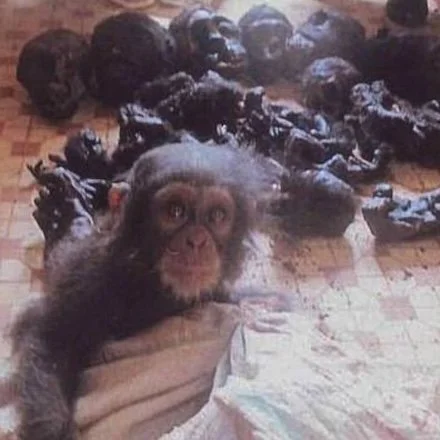
Daphne surrounded by her butchered family (photo credits - LAGA)
What is the illegal wildlife trade?
The illegal wildlife trade is the buying and selling of wild animals, their body parts, or products derived from them, outside of the law. It is one of the most profitable criminal industries in the world, estimated to be worth billions of dollars annually, sitting alongside drug trafficking, arms dealing, and human trafficking as one of the largest illegal trades on the planet.
For great apes specifically, it takes two main forms. The bushmeat trade, where primates are hunted and killed for their meat, and the pet trade, where infants are taken alive and sold, often internationally, as exotic pets or for use in entertainment.
Both are devastating. And both are happening right now.
The scale of the problem
The numbers are difficult to read, but they need to be said.
A landmark report from the United Nations Environment Programme estimated that at least 2,972 great apes are lost from the wild every single year through illegal trade alone, either sold, killed during capture, or dying in captivity. More recent data from CITES, the international body that regulates wildlife trade, shows that between 2000 and 2023, more than 6,000 African primates were traded internationally across 50 countries, with chimpanzees accounting for 37% of all seizures.
And those are only the cases we know about. Every great ape confiscated or confirmed in the illegal trade represents many more that died either during capture or the trafficking process. The true scale is almost certainly far worse.
What it actually costs
To take an infant primate alive, hunters almost always have to kill the mother first. And in most cases, every other adult in the group who tries to protect her. A single infant taken from the wild can mean the deaths of ten, fifteen, or more family members. Sometimes an entire group.
In December 2004, government authorities raided a hunting camp in the east of Cameroon. The only primate found alive was a tiny infant gorilla named Nona, just two weeks old and still with traces of her umbilical cord. Her mother had been killed and butchered. Her flesh was being smoked outside the camp. Nona was discovered inside a hut, surrounded by the bodies of dead primates prepared for sale. Too weak to eat, she had been thrown scraps she could not digest. By the time our team reached her, she was barely breathing, severely dehydrated, wounded, and close to death. She required feeding every fifteen minutes and treatment for multiple infections in the days that followed.
Nona’s rescue from a hunters camp in 2024
In 2006, a young infant gorilla named Shufai arrived at Ape Action Africa with gunshot wounds to his head and arm. His mother had been killed by hunters. Before he was found, he had been tied to a bed in a village where children and dogs had tormented him for days. The damage caused by the bullet to his arm never fully healed. For years he lived with chronic pain, until in 2013 our team made the difficult decision to amputate the arm in order to give him relief. It was not a decision taken lightly. But leaving him in constant pain was not an option.
Shufai’s arrival to Ape Action Africa
In August 2024, a young gorilla named Barbie arrived with a bullet fragment lodged in her head from the same shotgun that had killed her mother, as she clung to her. She was frightened, vulnerable, and at the very beginning of a long recovery.
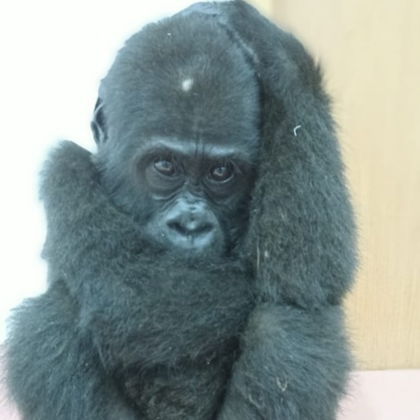
Barbie holding her head in pain from shogun pellets lodged in her skull.
These are not statistics. They are individuals, each with their own history, their own trauma, and their own capacity to suffer.
Why does it keep happening?
The honest answer is that it keeps happening because it is profitable, and the consequences of being caught are rarely severe enough to outweigh the financial reward.
In many parts of Central and West Africa, poverty is a significant driver. For communities with limited economic alternatives, hunting primates for bushmeat or selling infants to traffickers can represent a meaningful income. This is not an excuse. But it is a reality that any serious effort to address the trade has to grapple with. Punishing people without addressing the conditions that push them toward this activity does not solve the problem.
At the same time, demand from wealthier countries continues to fuel the trade. Baby chimpanzees and gorillas are sought after as pets, particularly in parts of the Middle East and Asia, where owning an exotic primate is seen as a status symbol. As long as that demand exists and as long as buyers face little consequence, the incentive to supply will remain.
Weak enforcement, limited resources for wildlife authorities, and in some parts of the region, corruption, make it easier for traffickers to operate. A primate can cross multiple national borders before anyone asks the right questions.
Is anything being done?
Yes, and there are genuine reasons for hope.
International agreements like CITES regulate the trade in endangered species, and in many countries the penalties for wildlife trafficking have been strengthened in recent years. Conservation organisations, governments, and local communities are increasingly working together to address both the supply and demand sides of the problem.
Community based conservation is one of the most promising approaches. When the communities living alongside wildlife have a genuine stake in protecting it, whether through employment, education, or shared benefits, the incentives begin to shift. At Ape Action Africa, building relationships with the communities around us is a core part of what we do, because long term change only happens when people feel connected to it.
Where they are today
Nona, the tiny two week old infant found barely breathing in that hunting camp in 2004, is now a fully grown gorilla. More than twenty years on, she lives within a stable social group at Ape Action Africa. Her care continues every single day.
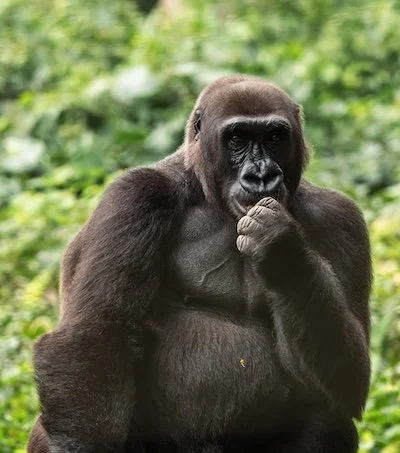
Nona Today - Photo Credits Ian Bickerstaff
Shufai, despite losing an arm to the bullet that was meant to end his life before it began, is today the silverback of his gorilla troop. Leadership in a gorilla group is not built on physical perfection. It is built on confidence, stability, and presence. Shufai has all three.
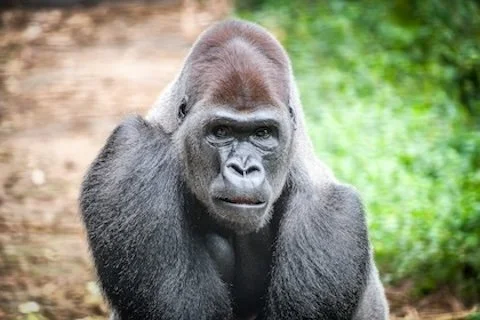
Shufai Today
Barbie is now part of a gorilla group, adopted by her surrogate mother Luci. She continues to grow in strength and confidence, surrounded by protection, stability, and long term care.
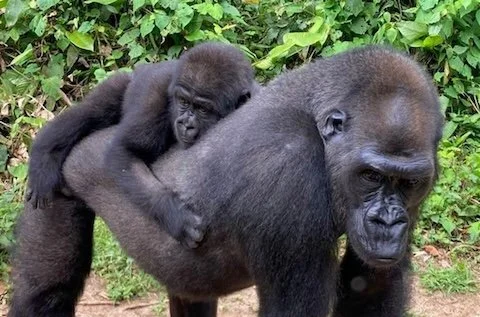
Barbie and surrogate mother Luci
Daphne, found cowering and screaming among the remains of primates killed for profit, is today intelligent, curious, and deeply compassionate. She lives within the safety of the forest, surrounded by routine and care.
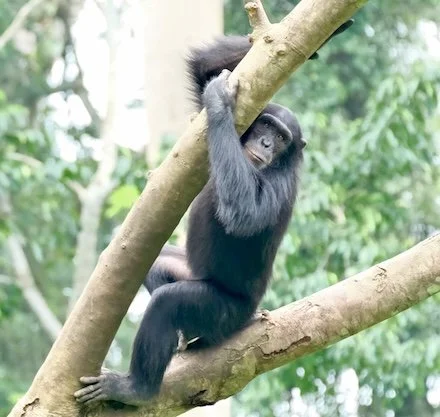
Daphne Today
Each of them survived something that should not have happened. Getting them to where they are today took years of daily work, veterinary care, patience, and unwavering commitment.
That work is ongoing. For every primate who comes through our gates.
What you can do
Never buy or keep a wild primate as a pet. Never support businesses or individuals that use primates for entertainment. If you see wildlife being traded illegally, report it. And if you want to support organisations caring for the primates who survived, your donations make a direct and tangible difference.
To support the work we do at Ape Action Africa, visit apeactionafrica.org/donate